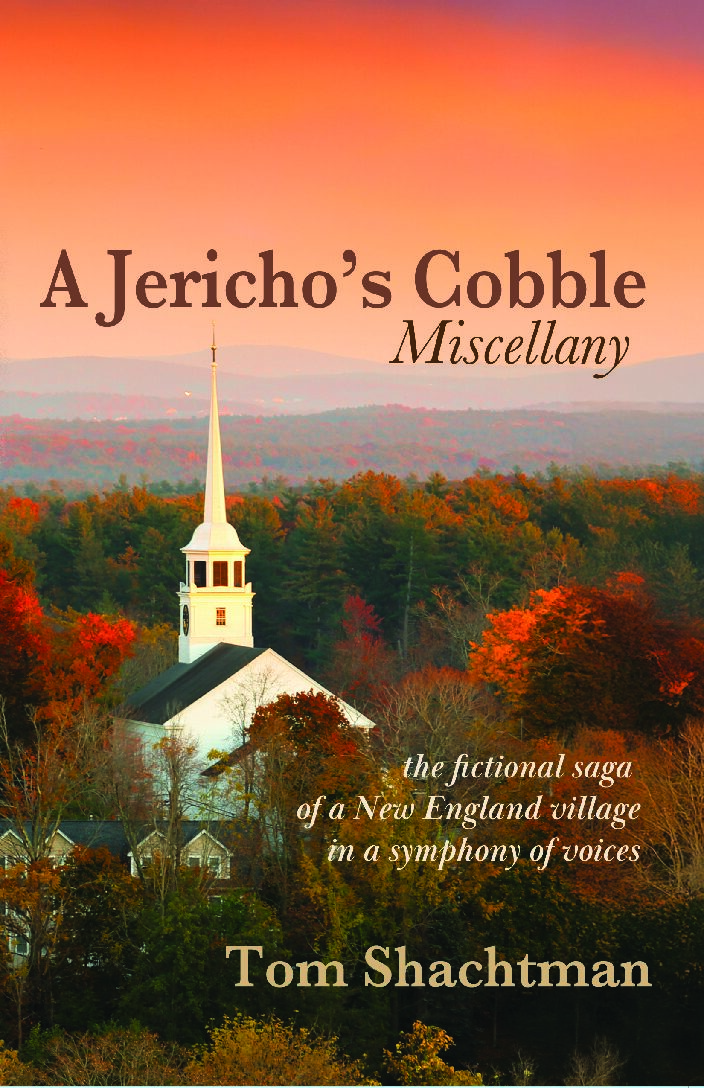
A genre-bending work similar to Edgar Lee Masters’ A SPOON RIVER ANTHOLOGY; this is a portrait of a fictional New England small town over the past several hundred years, its stories recounted by more than a hundred voices, those of the living – white, Black, Native American, male, female, gay – and of the dead, and also of inanimate objects – a neglected upright piano, a bench along a nature trail – in poems, dialogues, roadside markers, tombstones, business brochures, newspaper articles, a playlet, diary entries, oral history transcripts, a stitched sampler, and even a nursery rhyme. Some tales are of quiet happiness, others of roiling passions, moral quandaries, tragedy and comedy; above all they speak to the centrality of community and continuity in our lives.
Praise for A JERICHO’S COBBLE MISCELLANY
“Shachtman’s literary novel chronicles life in a humble New England village, a rural place though not a remote one. From a babysitter’s diary to the thoughts of an abandoned barn, to a guitarist looking to make a go in the big time, the fun comes from seeing what each new perspective will reveal. Surprises abound. An invitingly varied and intimate look at what makes a small town tick.” – Kirkus Reviews.
“A patchwork quilt, stitched from voices, artifacts, and memories. It’s messy and alive, much like the New England hamlet it captures. I found myself laughing at one passage and then feeling the weight of grief a page later. A Jericho’s Cobble Miscellany is about what it feels like to live in the shadow of history while stumbling through the present. I would recommend it to readers who want to sink into the rhythm of a small town that is both ordinary and mythic. If you’re willing to wander, to let yourself be surprised, you’ll find something touching here.” – April Pulliam, Literary Titan.
“I loved it. Rich in detail, every turned page a surprise, the different voices, animate and inanimate (I got a special kick out of ‘Lament for an Upright’), the vivid imagination, and much more.” — John G. Ryden, Director Emeritus, The Yale University Press.
“I really love it. The orchestra of voices, alive and dead, works very well in evoking the feeling of place, the history of it, the complexity. I especially love the use of signs, epitaphs, markers, newspaper, transcripts, to evoke the whole community and the richness of each part of the town. I feel curious and connected all the way through,. It is the very movement between forms that keeps me reading. Each of the voices feels fully realized and fleshed out, even when brief. And the cumulative effect is that of a chorus, each holding a part of the story.” — Eiren Caffall, 2023 Whiting Prize Winner and author, THE MOURNER’S BESTIARY; and ALL THE WATER IN THE WORLD.”